The Maya Train route: everything you need to know

This article lays out everything you will need to help you decide whether you want to take a ride on the Maya train when exploring Mexico’s Yucatán Peninsula. I have taken the train a few times now, and as you read through the article you’ll find boxed sections with my personal experiences & opinions as well as the cold, hard facts.
The Tren Maya Project transports passengers around the five most southern Mexican states: Chiapas, Tabasco, Campeche, Yucatán and Quintana Róo, linking major tourist sites and cities such as Chichén Itzá, Cancun, Bacalar, Mérida and Palenque.
According to the official sites, the Maya train route showcases the best of southern Mexico as it weaves together history, culture and nature along its 1,500km of track between cities, along the Caribbean Coast and deep into the remote southern jungles.
A note: all opinions in this article are my own. I have never been hosted on the train, in fact, the first time I took the train, I ended up paying twice for my ticket because I naively assumed that as a permanent resident of Mexico I’d be entitled to resident ticket prices. Not only was I not, I also wasn’t permitted to pay to make up the difference in ticket prices, I was required to buy a whole new ticket (I understand that others have been shown grace and allowed to just pay the difference, sadly, I was not).
There are affiliate links in this article. If you click and make a purchase I could make a small sum at zero cost to you. Thank you!
What are your transport options for travelling around the Yucatán Peninsula?

🚆 Train – it is possible but it’s not yet quite as easy or smooth as the Maya train enthusiasts (i.e. officials) might have you believe to travel all the way around the peninsula. You’ll need to buy individual tickets for your various journeys and keep careful track of what/when/where you’re doing things. My opinion is that the train is great for visitors moving slowly from area to area rather than day trippers or anyone wanting to zoom around.
🚌 Bus – the peninsula is well connected through a good network of intercity and smaller town buses. If you wish to use public buses for day trips or to get yourself around the peninsula, this is very possible. You can check timetables and book tickets in Spanish on the official ADO site or in English on BusBud. After a slight fiasco where ADO cancelled my tickets without either telling me or refunding my money, I now recommend only buying tickets on BusBud.
🚗 Rental car – The Yucatán Peninsula is extremely easy and safe for road trips. I have driven around the entire Maya train route at various times and never once felt unsafe.
→ Check rental car availability and prices
➕ Read the MexicoCassie guide to renting cars and driving in Yucatán
And yes, people do ride 🏍 and 🚲 around the peninsula too.
You’re still reading so you’re probably considering taking a ride on the train! Time then, to dig down into the details and admin of sorting out your trip around the Maya train route.
The rest of the article is split into the following sections:
🗺 The Maya train route | 📌 The Maya train must knows | 🎟 How to buy your tickets | 🚆 Riding the train and train services | 🚕 Getting to & from the stations | ♻️ Construction concerns | ⭐️ Route details and specifics | 🧑🏽⚖️ MexicoCassie train verdict
🗺 The Maya Train route

✈️ Cancun International Airport, Mérida International Airport and the new Tulum International Airport are all within easy reach of a train station.
The Maya train route is designed to serve the needs of both tourists and locals. It has 34 stations and stops (destinations) in 5 states, of which, apparently 20 are stations and 14 are stops.
When the route first opened, the difference between a station and a stop was described thus:
🚉 Train Stations (ESTACIONES) – the stations are located to provide access to tourist destinations
🚉 Stops (PARADAS) – the stops are for more local travel, offering locals easier travel around their home region
Currently, the Tren Maya website sees a station is a gateway to excitement and adventure, while a stop is somewhere to connect with the tranquility of nature. I quite like this as it might encourage visitors to explore deeper into the Peninsula, away from the main tourist sites.
My experience (both on the train and from talking to people) is that the train is really useful for local people moving around the peninsula, getting home to their smaller towns and villages from their places of work in the bigger cities. Foreign tourists are using it but not yet in the numbers hoped for.
If you are interested in historical sites, cultural heritage, pristine beaches and natural beauty then for sure you are going to find plenty to enjoy as you travel around the complete route of the Mayan train.
The Maya train route provides access to:
⭐️ 23 Pueblos Mágicos (Magical Towns – seven of which are actual stops along the route)
⭐️ 5 major cities (Cancun, Playa del Carmen, Valladolid, Mérida & Campeche)
⭐️ 6 UNESCO World Heritage sites – including Chichén Itzá and the city of Campeche
⭐️ 5 Protected natural areas – each of the five states through which the train runs is home to protected areas such as Calakmul Biosphere Reserve in Campeche and El Triunfo Biosphere Reserve in Chiapas
⭐️ 50+ Archaeological zones – from the Mayan and Olmec civilisations including world famous ones such as Palenque, Tulum and Chichén Itzá to magificent smaller and almost unheard of sites like Xcambo, Aké and Becán
⭐️ Numerous beautiful beaches across Tabasco, Campeche, Yucatán and Quintana Roo
⭐️ Hundreds of cenotes, primarily in Yucatán and Quintana Roo
📌 Maya Train – must knows

All aboard!
♿️ Trains are accessible for people with limited mobility and there is space for wheelchairs aboard the trains.
🚾 Bathrooms on the train are spacious, modern and accessible – there are hand rails, easy to press buttons and there’s also a baby changing table in each bathroom. The toilets are clean and always open.
🛄 According to official requirements, each passenger is entitled to take one large suitcase (no more than 25kg, size 55cm x 40 cm x 25 cm) but honestly, no one was checking when I travelled. Much like any old train, there’s some space for cases at each end of the carriages and there’s also overhead space.
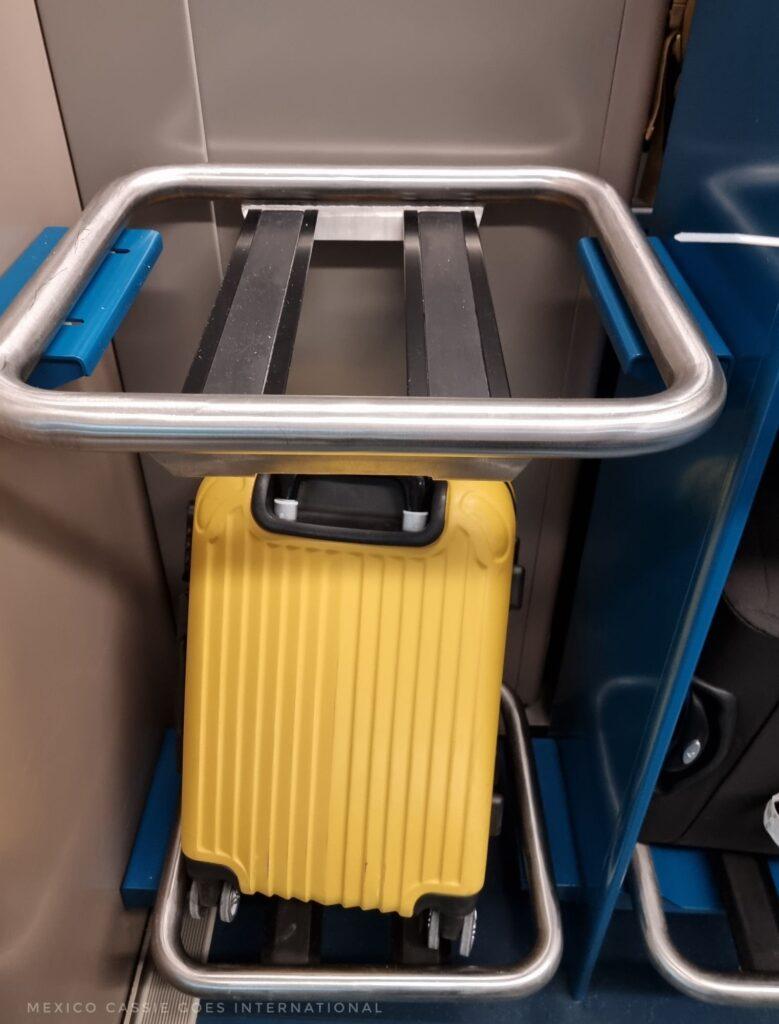

Yes, these photos are dull but they’re useful to see what the luggage space looks like before you travel
🐾 According to the official website, certified service and emotional support dogs are permitted on the train, as are small dogs/cats (weighing under 10kg) but I highly recommend verifying this before buying your tickets.
📲 I didn’t notice wifi on the train but it might have been there. There are charging points for every seat between the big cities. Even regular cell coverage is spotty so don’t expect your phone to be your source of entertainment on the train.
🎟 How to buy your train tickets
💻 The official Tren Maya website, in my opinion, is not an easy website to navigate. It feels overly complex given that its one real job is to sell train tickets.
🇬🇧 🇺🇸 To find the English language option, hit the “compra tus boletos” (buy your tickets) tab and then you’ll see the option for English.
💲 Tickets are purchasable directly via the website but weirdly, and annoyingly, how far in advance you can buy the tickets seems also to constantly change.
🙋🏽♀️ It is also possible to buy tickets at the stations, in person.
🪪 Be warned that although Mexican residents are meant to have the same rights as Mexican citizens, on this train you do not. Residents are required to buy tourist tickets. I learned this the hard way, sadly.
👶🏽 Children under 2 who do not need a seat, don’t pay. Otherwise, you select a child’s seat (2 – 12) and then it seems pay a full price.
👵🏾 There is not currently a discount for non-citizen seniors.
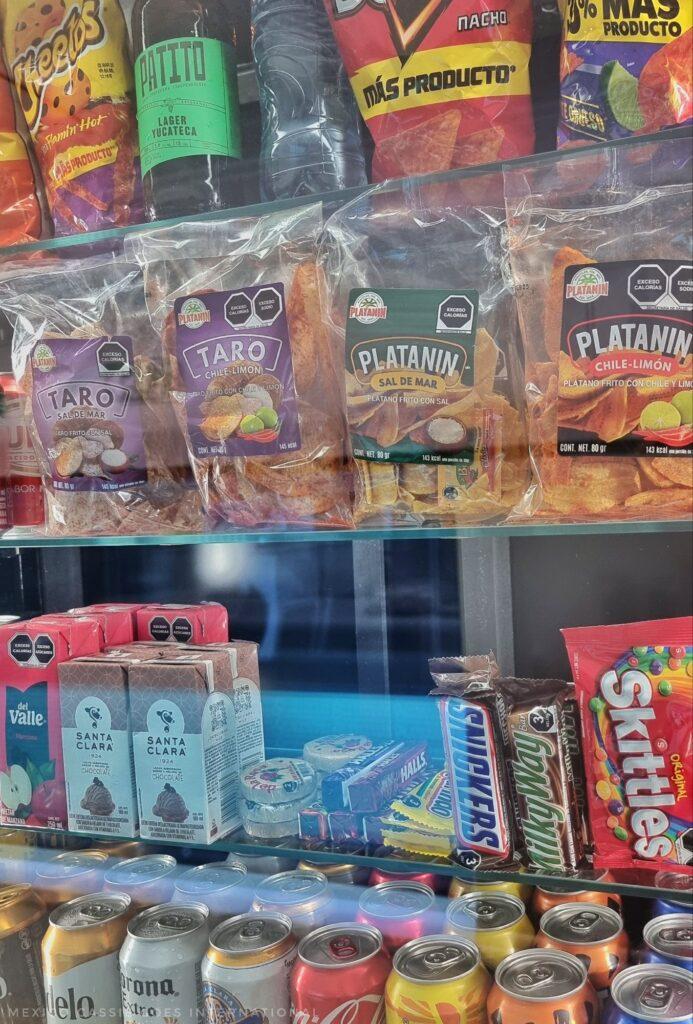
⭐️ You can choose between tourist class and premier class tickets – on longer train rides the premier class ticket comes with a meal. In tourist class you have access to a small buffet car selling snacks and drinks. The prices are, of course, slightly elevated but they aren’t too bad. You can also take your own snacks onboard.

💤 There is the expectation of sleeper trains but as of 2026 these are still not up and running.
🪟 I noticed that, like aeroplanes, not all seats have a window. In my carriage, seats 8,9,10 and 12 had no window.
My experience of riding the train
I found the carriages to be spacious, clean and modern but if you’ve ever travelled by train before, the Maya train is just a train. The Chepe trains that run through the Copper Canyon are much bigger and feel way more exciting to ride. This is a regular inter-city train.
I travelled on a tourist class ticket between Cancun & Valladolid. I have also travelled premier class between Cancun – Bacalar in both directions.
Each time I’ve taken the train, I have shown my ticket and ID to a member of staff and was then directed to a waiting room. Upon boarding the train, there has always been plenty of space for my luggage. The first time I took the train there was definitely a sense of adventure and excitement on the train as we set off. My carriage was full of Mexicans who happily got down to enjoying their picnics and taking selfies of themselves on the new train (tbf I did exactly the same 😉)
The Maya train staff are extremely friendly and kind and I’m sure there will generally be someone who speaks English floating around to help. The staff come around to check tickets, there is a buffet car and a snack trolley. And staff even came round once or twice to check people knew when to get off. There is also a digital ticker announcing stations but I thought it was very sweet that someone came to tell me personally that my stop was coming up.
My favourite part of the train ride was actually how happy & friendly everyone was but that’s just Mexico for you. My least favourite thing was how boring the views were.
🚕 Getting to and from the stations
🧭 Unlike many other rail systems around the world, the Maya train stations are located outside of the cities, towns and destinations they serve meaning you’ll need to take a bus or taxi to get to the station.
Cancun – to/from the airport there is a bus that costs $35 pesos, buy before boarding the bus. To/from downtown the bus costs $55 pesos.
Mérida – Va y Ven electric buses run between the station and La Plancha & Paseo 60 – buy the ticket in the station before boarding.
Campeche – buy ticket on the bus, costs $18 pesos – goes to the malecon and downtown.
Valladolid – one bus and many taxis waiting for arriving trains. Easiest way to reach the station is by taxi as it’s close and not expensive. The bus runs to the ADO station and costs $36 pesos.
Tulum – there is a bus running between Tulum train station and downtown as well as the airport. The bus costs $55 pesos.
Bacalar – There is a minibus that costs $25 pesos in each direction – note that it’s worth buying your return at the station when you arrive as otherwise you’ll have to go to the ADO station to buy it. The bus can drop you off at the fort/main plaza or the ADO bus station, which is further from town. You can sometimes buy your return ticket as you board but not always (I know, but it’s true).
My experiences
Getting from Cancun airport to Cancun train station
There is a shuttle bus between each airport terminal and the train station. However, it currently runs only with enough time to get you onto your train so when I arrived at the bus stop I had to wait almost an hour for the bus.
There is no bench, no shade, and no waiting room. My new (Mexican) train riding friends and I decided we couldn’t risk waiting inside the airport terminal as we didn’t really know how reliable the bus timetable was. So there we stood, chitchatting for a long, sweaty time waiting for the bus. And the bus, weirdly, is a traditional coach rather than a sensible airport bus meaning luggage has to be stowed underneath, which of course slows everything down.
Getting from Valladolid train station to Valladolid
I got off the train in Valladolid and went for a pee. I was the only person to get off the train in Valladolid. The bus had already left after my (2 minute?) pee delay so I took a cab. Cabs are plentiful and in Valladolid in November 2024 cost $150 pesos into the city.
♻️ Why has there been concern over the Maya Train route?
No matter how exciting this new train might be we shouldn’t forget that there has consistently been controversy over this Mexican government project since its inception and throughout the period of its construction. Activists remain worried about former Mexican President, López Obrador’s, pet project and its impact on the environment.
It’s true that the pristine wilderness of the Yucatecan jungle has seen big changes during the construction of the railway line. Environmental activists say that fragile ecosystems and wildlife routes across the dense jungle floor have been destroyed. There has also been concern over the possible damage to as yet undiscovered archaeological sites as the ground was prepared for the train line. We must watch and hope that the damage isn’t too severe and that environmental concerns can be mitigated or offset.
I’ve also read reports, though that suggest much of the railway has been built over existing rail lines and roads that were already there.
Route details & city specifics
When is the best time to visit this region of Mexico?
🔆 Warm and Dry: November – March. The weather is just about perfect for exploring. The nights are considered cool by locals and anyone who has lived here long enough to fully adjust to tropical climes when it drops to 20C / 68F at night.
🔆🔆 Hot: April – May. This is the hottest time of the year. High temperatures are the norm and regularly reach over 40C / 104F. Humidity is at its peak (remember that jungle areas will always be humid)
🔆 ☔️ Hot and Wet: June – September. Most days are extremely hot and humid and there are regular aguaceros (heavy rain storms) for an hour or so in the afternoons.
The train route covers 5 states: Quintana Roo, Yucatán, Campeche, Tabasco, and Chiapas. In this section of the article you’ll find useful information about the states, the train station locations
Stations in Quintana Roo
Stations: Cancun airport, Puerto Morelos, Playa del Carmen, Tulum (and airport), Felipe Carillo Puerto, Limones-Chacchoben, Bacalar, Chetumal, Nicolas Bravo, Leona Vicario, Nuevo Xcán
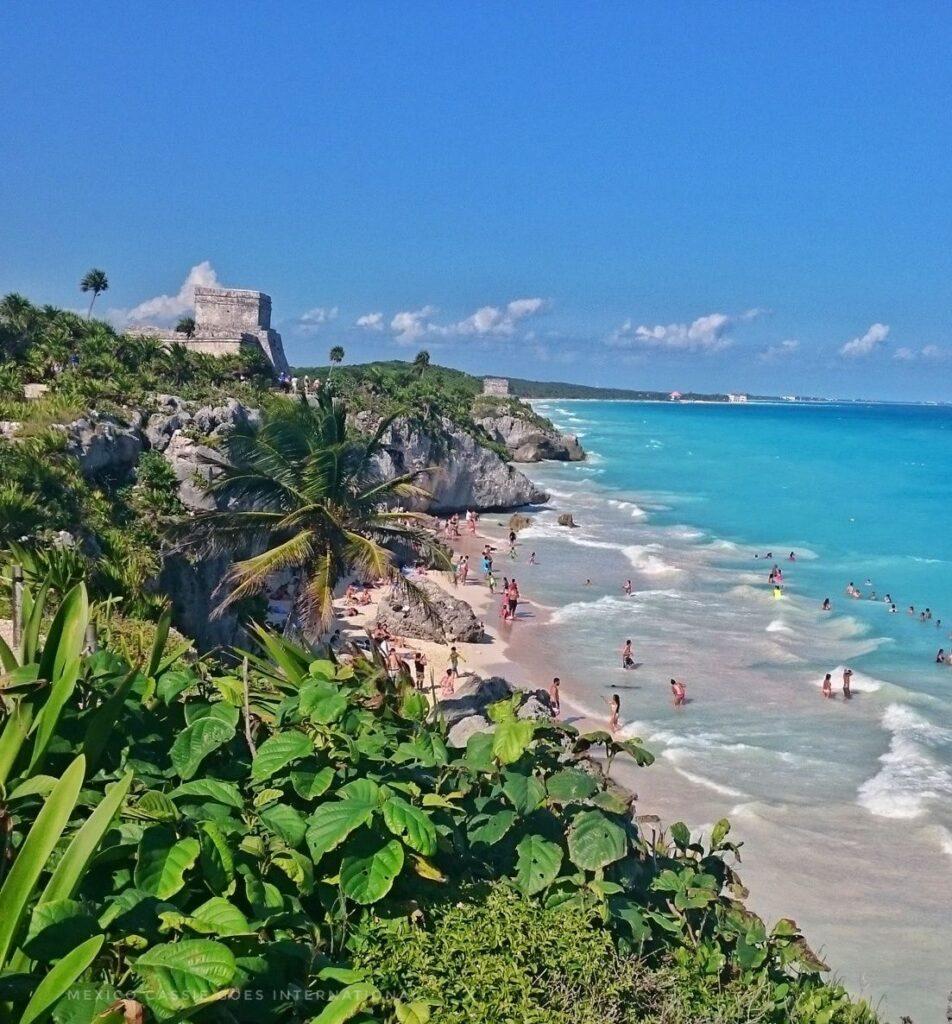
Quintana Roo is most famous for being home to the Riviera Maya (also known as the Caribbean Coast) with its sparkling white sand beaches, gorgeous turquoise waters, all inclusive hotels and great snorkelling/diving opportunities.
✅ Highlights – take an island day trip to Cozumel, Isla Mujeres or the deserted Isla Contoy. Enjoy diving, go shopping on the famous Playa del Carmen‘s 5th Avenue or play on the beach in Tulum. In Cancun, enjoy the excellent beaches, nightlife and beach resorts for all budgets. Visit the ancient ruins of Tulum and Muyil, swim with turtles in Akumal, explore cenotes, explore the Si’an Kaan Biosphere. Marvel at Bacalar’s breathtaking laguna de 7 colores, swim the Canal de los Piratas.
MexicoCassie’s Quintana Roo guides
Stations in Yucatán
Stations: Valladolid, Chichén Itzá, Izamal, Tixkokob, Teya-Mérida, Uman, Maxcanú
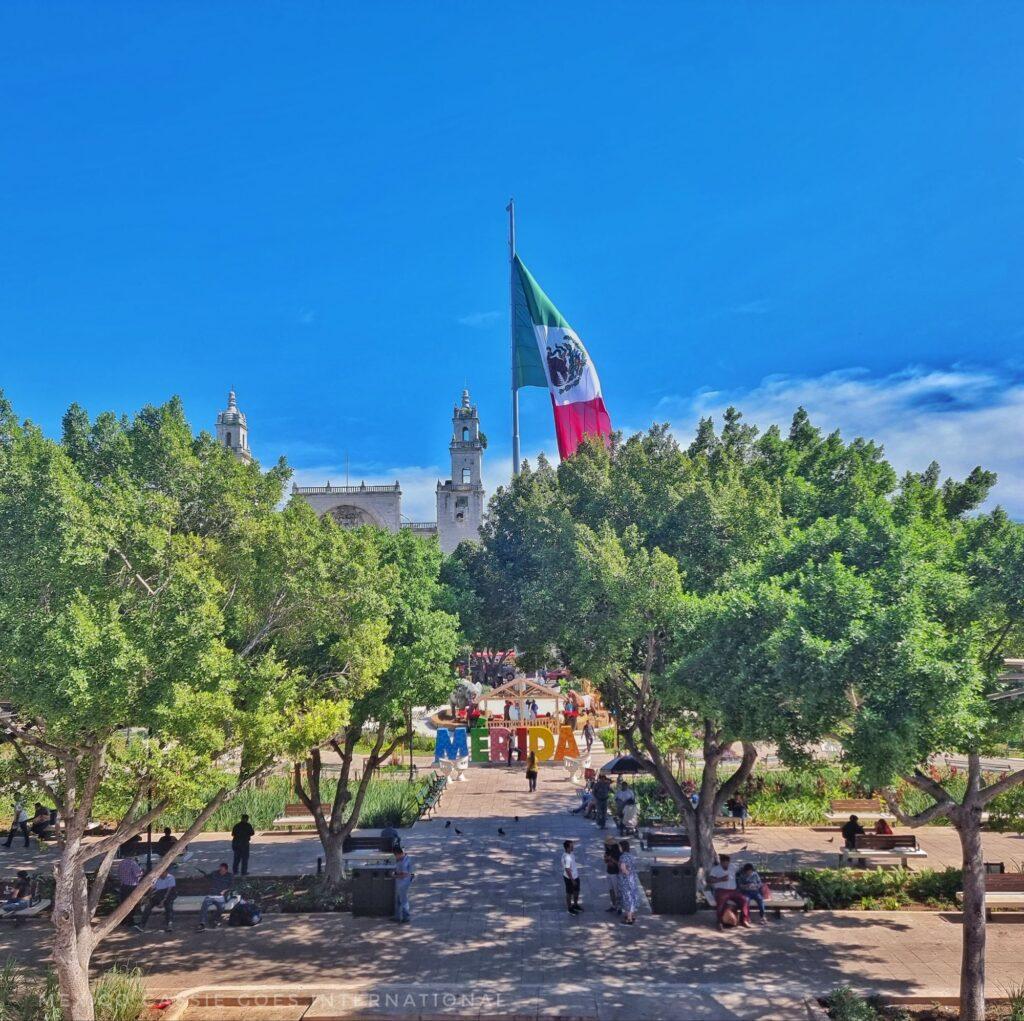
Yucatán is famous for being home to the modern world of the world and UNESCO World Heritage Site, Chichén Itzá, and the colonial cities of Mérida & Valladolid.
✅ Highlights – explore the numerous Mayan ruins, including the big 3 – Chichén Itzá, Ek Balam and Uxmal. The incredible colonial architecture in Mérida is a big draw for many. Valladolid, a smaller, yet still gorgeous colonial city is a draw for foodies. Izamal, the yellow city (and pueblo magico) is a fascinating old city that is also an Instagrammer’s dream since almost all the buildings in the city centre have been painted yellow. There are pyramids and ruins aplenty to explore here. And of course, you can’t miss the Gulf of Mexico’s gentle Costa Esmerelda, the pink lake at Las Coloradas and the cenotes that are all around Yucatán.
MexicoCassie’s Yucatán guides
Note: it has also be suggested that at some point in the future there will be an extension of the line to Progreso, which would make sense given that it’s a major cruise ship port.
Stations in Campeche
Stations: Calkiní, Hecelchakán, Tenabo, Campeche, Edzna, Carrillo Puerto, Escárcega, Centenario, Calakmul, Xpujil, Candelaria
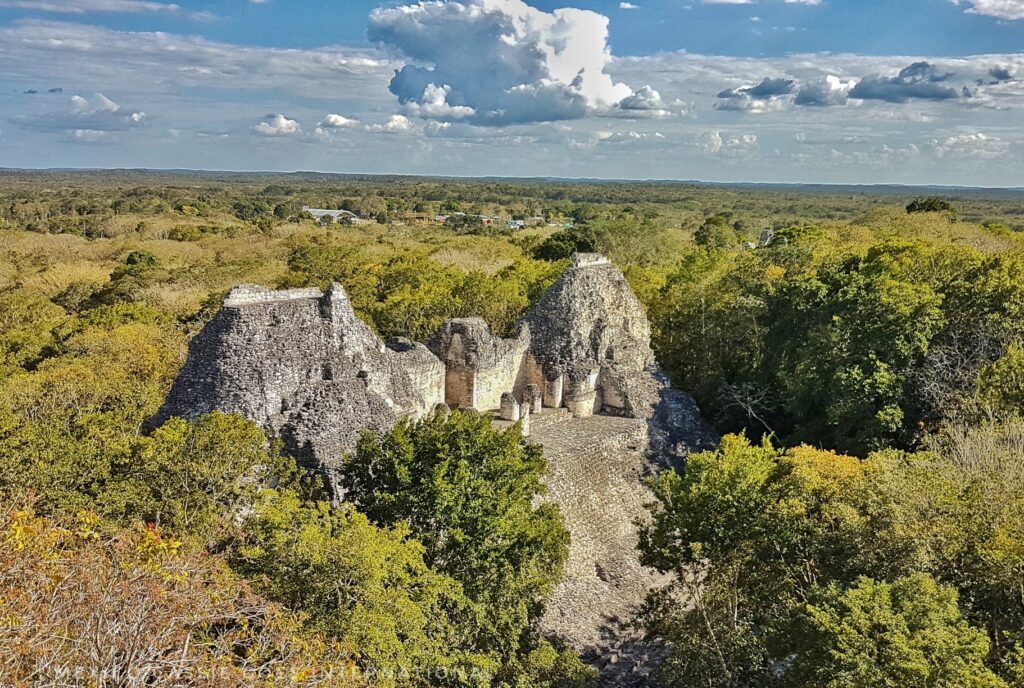
Campeche is famous for the incredible ruins in the Calakmul Biosphere.
✅ Highlights – the Maya ruins deep in the Calakmul Biosphere, Edzna, and the small colonial city of Campeche.
MexicoCassie Campeche guides
Stations in Chiapas
Stations – Palenque
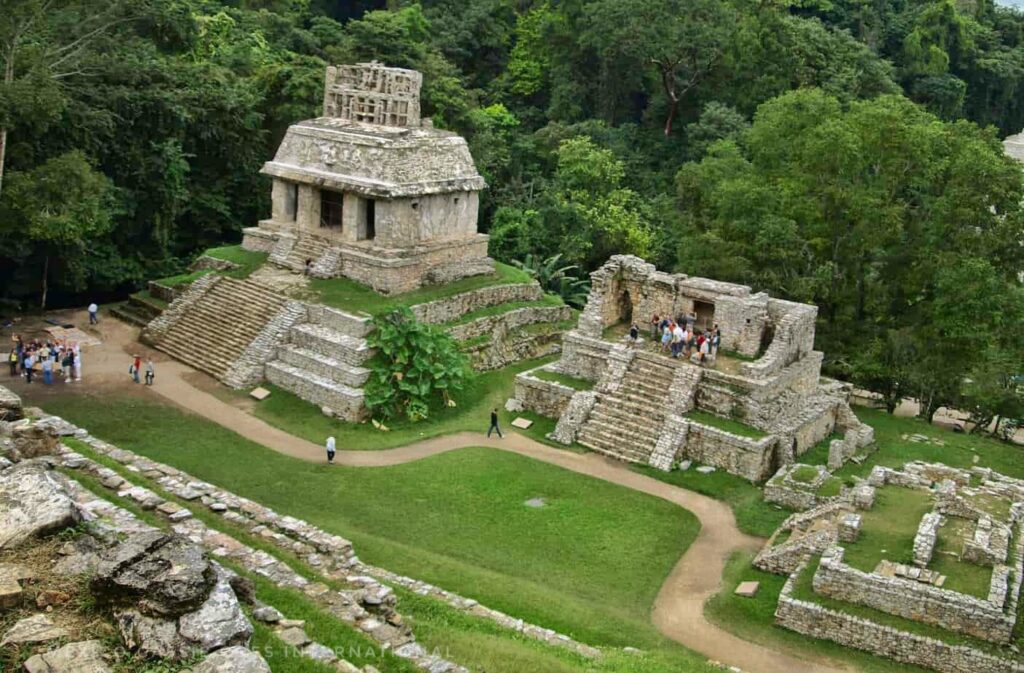
Chiapas is most famous, of course, for the incredible archaeological site of Palenque. San Cristobal de las Casas is a very popular tourist destination within the state too, although it’s not reachable via the train.
✅ Highlights – Palenque, Pantanos de Centla Biosphere (one of the biggest wetland areas in all of Mexico) and the Usumacinta Canyon. From Boca del Cerro it’s also possible to visit Yaxchilán, an ancient Mayan ruin on the banks of the Río Usumacinta along the border with Guatemala (which I visited on my honeymoon in 2009). It’s also possible to visit the Agua Azules waterfalls and Palenque national park from Palenque town.
Mexico Cassie Chiapas guides
Stations in Tabasco
Stations – El Triunfo, Tenosique, Boca del Cerro
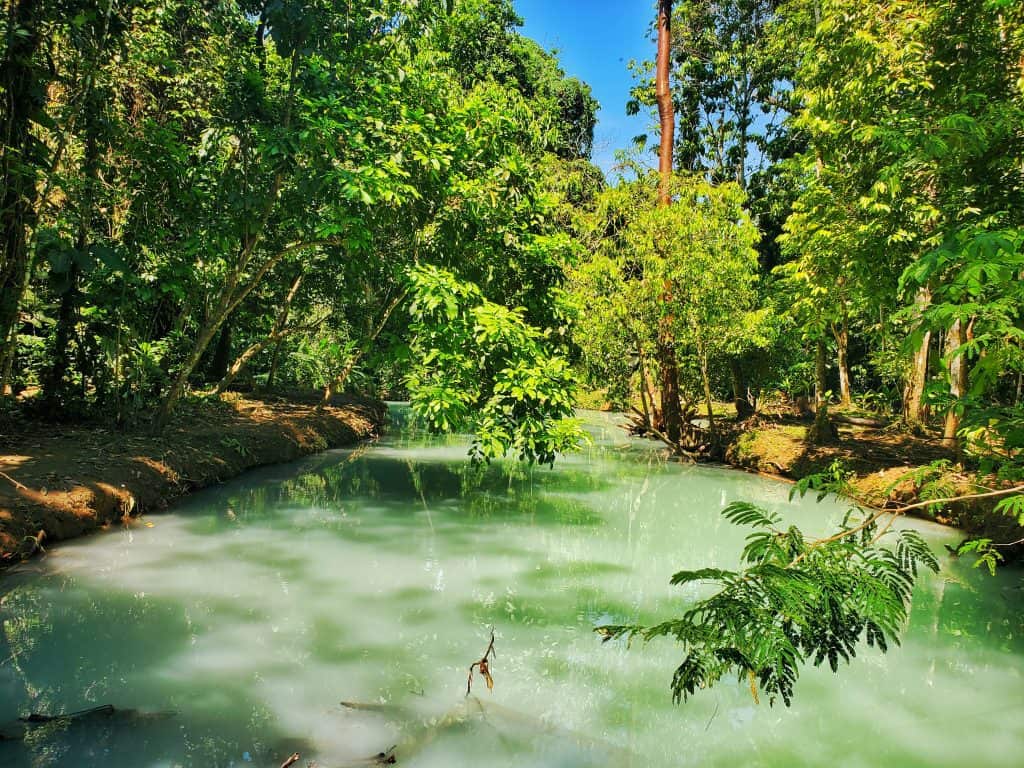
Tabasco is not a state that is particularly on the Mexican tourist trail. Perhaps now that the train runs through here, it’ll see more visitors. I have been to Tabasco but to the other side of the state, around the small town of Tapijulapa.
✅ Highlights – go hiking in the Biosfera Wanhá, visit the Reforma Waterfalls by kayak, check out the Moral-Reforma ruins. From Tenosique you can take a boat ride through the Usumacinta Canyon, see as-yet-unexplored ruins, float through the Santa Margarita Springs.
So, after all this, what’s the MexicoCassie verdict on the Maya train?
It’s ok 😂. It didn’t wow me but it didn’t make me hate it either. It didn’t feel super special to me because I’m European and use trains a lot. It is a really nice, clean, and modern train though. I know that’s not a sensationalist opinion that will make headlines around the world but it’s all I’ve got for you. Sorry.
It’s a hassle to not be able to book tickets until so close to travel, I resented paying full price as a resident and it’s a bit of a pain that the stations are out of town. However, it was a pleasant ride and everyone was very friendly.
The section of the route I travelled was short and wasn’t particularly interesting. I’d hoped to also take the train from Mérida to Campeche for a day but the timetable doesn’t allow for day trips yet. I’d also considered taking it from Mérida to Cancun but in the end I didn’t have enough confidence in it as we’re still hearing reports of delays and obviously, I couldn’t afford to miss my flight back to Spain. I don’t like buses very much (I get motion sick on buses) but I still chose the tried and tested ADO option over the train.
With regard to the environmental concerns, yes, I have some but I’m not a specialist and I haven’t spent time deep diving into the pros/cons/rights/wrongs of it all. Do I hate the destruction of jungle and ruins? Of course I do. I think both are nuts but as I wrote above, apparently much of it was built over existing structures. Do I think the train was necessary? Nope, it wasn’t. But it’s here now.
Would I use it again? Maybe. Probably. I’d probably use a mix of all transport options were I to do a longer trip around the Peninsula. I’d use the train to get down to the places in Tabasco I haven’t yet seen for sure.
Are there other train lines in Mexico?
You may not know it but yes, there are other train routes in Mexico that you can enjoy.
🚂 El Chepe (the Chihuahua Pacifico) runs through the Copper Canyon region of Chihuahua, and Sonora in northern Mexico. It, too, offers tourist trains and local trains.
🚂 Tequila Express / José Cuervo Express – this is a purely tourist experience that transports visitors from Guadalajara to the small pueblo magico of Tequila. It is considered something of a party train since it includes mariachi bands and tequila tastings!
🚉 CDMX has a comprehensive metro service
More Mexico adventures
🏔 Copper Canyon series
How to book your trip through the Copper Canyon
How to make the most of a trip to the Copper Canyon Adventure Park
Visiting Bahuichivo & Ceroachui
🚗 Mexico road trip ideas
An epic southern Mexico road trip through Campeche, Tabasco & Chiapas
Lesser known Yucatán adventures – 10 days
Yucatán road trip – 2 weeks
➕ Read the MexicoCassie guide to renting cars and driving in Yucatán
🥾 Mexico adventures – other
Everything you need to know about seeing the monarch butterflies in Mexico
How to visit the Grutas de Tolantongo in Hidalgo
San Cristóbal de las Casas as a great adventure base
Chiapa de Corzo & the incredible Sumidero Canyon
Exploring the Pueblos Mancomunados from Oaxaca
Getting deep into Queretaro’s magical Sierra Gorda region
Wine tasting in Baja California
Visiting the ghost town of Mineral de Pozos (Guanajuato)
Excellent day trips from San Miguel de Allende
What to do in and around Puebla (including visiting volcanoes)


1 Comment
Ruth · 09/01/2025 at 6:12 am
Excellent information and first hand experience.
Comments are closed.